Diverse Abilities Programs
Programs and workshops designed to create accessible schools, workplaces, and communities through education, empathy, and experience.
Disability awareness that turns uncertainty into confidence.
Diverse Abilities teaches people what to say, what to do, what to notice and how to respond when interacting with those of us who navigate the world differently.
Through lived experience, real-life scenarios and practical education, our aDAPT programs help youth, workplaces and communities move beyond simply being accessible to creating interactions and spaces that are truly usable, inclusive and welcoming.
Accessible is a word. Usable is an experience.
Disability can feel uncomfortable. It doesn’t have to.
Many people want to be inclusive but worry about saying the wrong thing, offering help the wrong way or making a mistake. Others simply don’t recognize barriers they have never had to navigate.
That is the gap our education helps close.
We create safe, engaging learning experiences where people can ask questions, challenge assumptions and build practical skills they can use in everyday interactions.
What to say. What to do. What to notice. How to respond.
Our Diversity Programs & Services
We have something for everyone!
Our aDAPT Programs & Workshops
a Disability Awareness Practical Teaching
Youth aDAPT
We start the conversations that grow compassion and empathy.
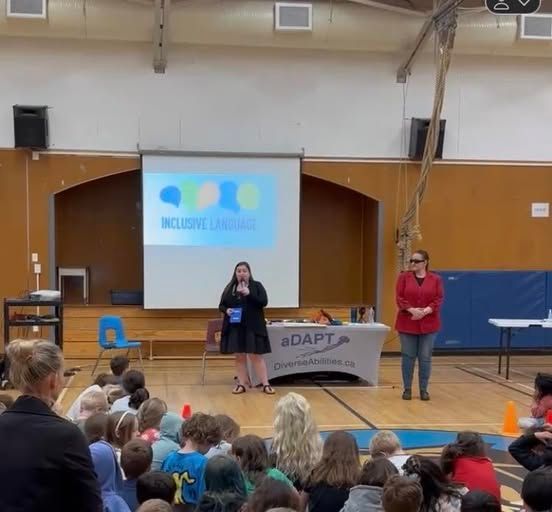
Youth aDAPT introduces students to disability, accessibility, inclusion and respectful interactions through age-appropriate conversations, activities and lived experience.
Students discover that people may navigate the world in different ways and that small choices can make it easier for everyone to participate and belong.
Available for classrooms, school assemblies and all youth organizations in Edmonton and Victoria, as well as online across Canada.
When we are kind to each other, everyone wins.
Bring Youth adapt to your school.
Community aDAPT
Creating communities where more people can participate and belong.
Community adapt brings practical disability awareness education to organizations, community groups, service providers and volunteers.
Participants build confidence interacting with people with apparent and non-apparent disabilities while learning to recognize everyday barriers, question assumptions and understand the difference between something being accessible and actually being usable.
Accessibility benefits all of us at different stages in our life.
“In an ideal world, everyone belongs”
adapt Workplace Inclusion
Inclusive workplaces start with confident people.
Your team may want to be inclusive but still be unsure what language to use, how to offer assistance, how to respond to disability-related situations or what barriers they may be overlooking.
adapt Workplace Inclusion uses lived experience, real scenarios and practical education to help employees and leaders communicate respectfully, recognize barriers and create more usable and welcoming workplaces.
This isn’t about memorizing a list of rules. It is about giving people the confidence to respond when real life happens.
Bring adapt Workplace Inclusion to your team.
Keynote Speaking
Real stories. Different perspective. Conversations people remember.
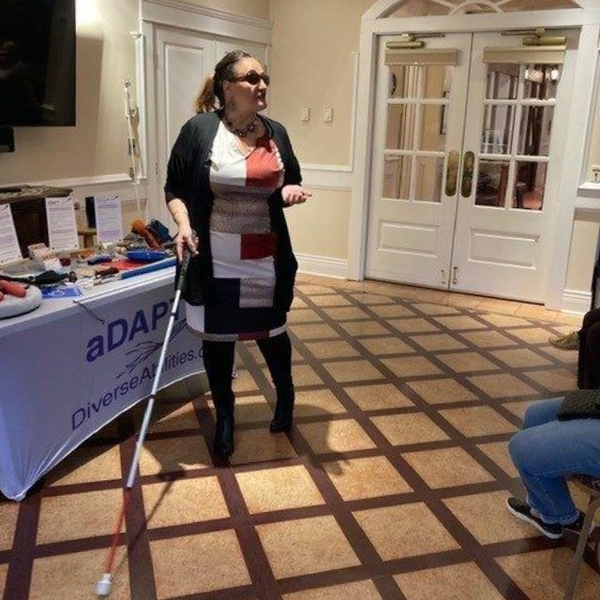
Gina Martin brings her lived experience, humour and practical disability awareness to conferences, workplaces, schools and community events.
Keynotes challenge assumptions about disability while helping audiences recognize how language, accessibility and everyday interactions influence whether someone feels welcome.
Vanessa and Gina each present their own personal lived experience journey with blindness, their challenges, triumphs, funny moments and important learning opportunities.
Knowing what to say and what to do, takes the guess work, normalizes our differences so no one feels awkward and everyone feels welcome.
Speaking opportunities can be customized for conferences, leadership events, professional development, Disability Employment Awareness Month, National AccessAbility Week and other organizational events.
We customize to meet the needs of our audience and goals of our client.
Bring Diverse Abilities Programs to your next event.
Sponsor & Donate
Empower our youth to encourage accessible futures.
Businesses organizations and individuals can help bring disability awareness education directly into classrooms by sponsoring a Youth adapt package.
Your sponsorship gives young people opportunities to learn about real life disability and the barriers people face from lack of awareness. in a safe environment and discover how their everyday actions can help someone else feel included.
It is an opportunity for your organization to align its community investment with
inclusion, accessibility and our next generation.
From an accident, illness or the natural process of aging, ALL of us will experience changes in our abilities .
“Accessibility benefits Everyone at different stages in our live,” #IDEALWorld
Help us build a futures that is accessible and welcoming for everyone, including us, when we age.
Thank You To Our Sponsors & Supporters

Meet our lead facilitators
Real people. Real conversations. Real lived experience.

Gina Martin
Founder, Educator, Author & Speaker
Edmonton, AB
Gina brings a unique perspective to every conversation she has decades of lived experience with multiple disabilities. She is passionate about making a meaningful difference by turning uncertainty into understanding and understanding into practical action.
Vanessa Pettinger
Lead Facilitator, Parent, Educator, & Speaker
Victoria, BC
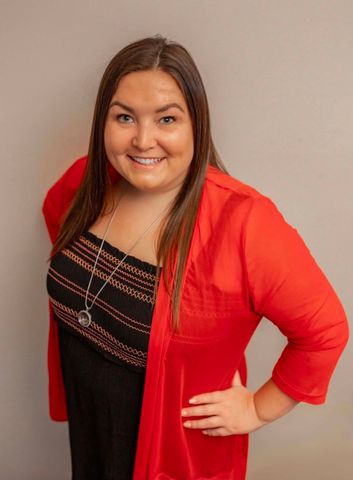
Vanessa brings lived experience, warmth, humour and an engaging approach to disability awareness education. Her passion for working with youth and communities help people discover that meaningful inclusion often begins with simple shifts in understanding.
Drawing from her own experience of adjusting to disability as a young parent, Vanessa is also passionate about helping families navigate and understand new diagnoses and changes in ability, whether affecting a parent, sibling, child or other family member.
Inclusion becomes meaningful when we know what to say and do.
You don’t have to know everything about disability to be accessible and inclusive. You need the willingness to learn, ask, notice and respond.
Small shifts become action. Over time, action becomes change.
Our Google Reviews
"Thank you for sharing how our programs & speaking have impacted you!"
Edit Google Reviews Widget
Get a Quote From Diverse Abilities
We’d love to hear from you. Call us now at 778-533-9876 or send a message using the form below we’ll get back to you as soon as we can.
Home Pg Form #1
Thank you for reaching out to Diverse Abilities. We look forward to learning more about your goals and exploring how we can support your group. A member of our team will be in touch within 3-5 business days.
Don't want to wait? Call 778-533-9876 to introduce yourself.
Please try again later.
Frequently asked questions
What is disability awareness training?
Disability awareness training helps people better understand disability, accessibility, inclusion, respectful language and everyday interactions with people with disabilities. Diverse Abilities Programs Inc. goes beyond awareness by using lived experience, real-life scenarios and practical strategies to help people feel more confident about what to say, what to do, what to notice and how to respond.
Where can I find disability awareness training in Edmonton?
Diverse Abilities Programs Inc. provides in-person disability awareness, accessibility and inclusion workshops in Edmonton, Alberta. Programs are available for workplaces, schools, community organizations, seniors, professionals and other groups, with training customized to the audience and their goals.
Do you offer disability awareness training in Victoria, BC?
Yes. Diverse Abilities provides disability awareness and inclusion education in Victoria and on southern Vancouver Island through our local facilitator. Programs are available for schools, organizations and community groups and can be customized for different audiences.
Do you offer online disability inclusion and accessibility training in Canada?
Yes. Diverse Abilities offers online disability awareness, accessibility and inclusion workshops for organizations, schools and communities across Canada. Virtual sessions provide an opportunity for teams in different locations to learn together and participate in real conversations about disability and inclusion.
What is disability inclusion training?
Disability inclusion training helps people understand how everyday language, environments, assumptions, policies and interactions can either support participation or create barriers. Effective training moves beyond simply knowing about disability and helps people develop the confidence and practical skills to create more inclusive experiences.
What is accessibility training?
Accessibility training helps people recognize and reduce barriers that can affect people with disabilities. These barriers may be physical, environmental, communication-based, technological or attitudinal. Accessibility is about much more than ramps and automatic doors. It is about creating environments, services and experiences that more people can actually use.
What is disability etiquette training?
Disability etiquette training teaches respectful ways to communicate, interact and offer assistance to people with different disabilities. It can include appropriate language, how to offer help without making assumptions, interacting with someone who is blind or has low vision, communicating with someone who is Deaf or hard of hearing, understanding mobility devices and recognizing non-apparent disabilities.
What is an invisible or hidden disability?
The terms “invisible disability” and “hidden disability” are commonly searched and used to describe disabilities that may not be immediately noticeable. At Diverse Abilities, we often use non-apparent disability. Someone may have a disability, health condition or different way of navigating the world that cannot be identified simply by looking at them. This is one reason assumptions can create significant barriers.
What is the correct term: disabled, handicapped, special needs or person with a disability?
Language continues to evolve, and preferences can differ between individuals and disability communities. “Handicapped” and “special needs” are generally becoming less common when referring to people. Terms such as “person with a disability” and “disabled person” are widely used today. When you are unsure how someone identifies, respectfully asking about their preference can be better than making an assumption.
How do I make my workplace, classroom or community more inclusive for people with disabilities?
Start by considering more than physical access. Clear communication, respectful language, flexible participation, usable spaces, accessible information and asking people what they need can all contribute to inclusion. Diverse Abilities workshops help organizations recognize barriers they may not have previously considered and develop practical ways to create more inclusive environments.
How should I interact with someone who has a disability?
Start with the person. Speak directly to them, communicate naturally and avoid assuming what they can or cannot do. If you think someone may need assistance, ask rather than automatically stepping in. Disability confidence develops when people have opportunities to learn, ask questions and understand different ways people navigate the world.
How can I learn about disabilities without being afraid of saying the wrong thing?
Many people want to be inclusive but worry about using the wrong word, asking an inappropriate question or unintentionally offending someone. Disability education can create a safe environment to learn, ask respectful questions and build confidence. Diverse Abilities workshops combine lived experience, practical strategies, real conversations and humour to help move people from uncertainty toward confident, respectful interaction.